
CONTROL High Availability Architecture
Overview
To achieve a robust high-availability (HA) architecture for CONTROL Device Management, Service Providers must comprehensively address both application implementation and operational requirements within their network infrastructure. This includes identifying critical points of failure and implementing appropriate HA strategies to mitigate them.
High-Availability Architecture Overview
The primary objective of an HA architecture is to guarantee uninterrupted application service in the event of component failure within the solution.
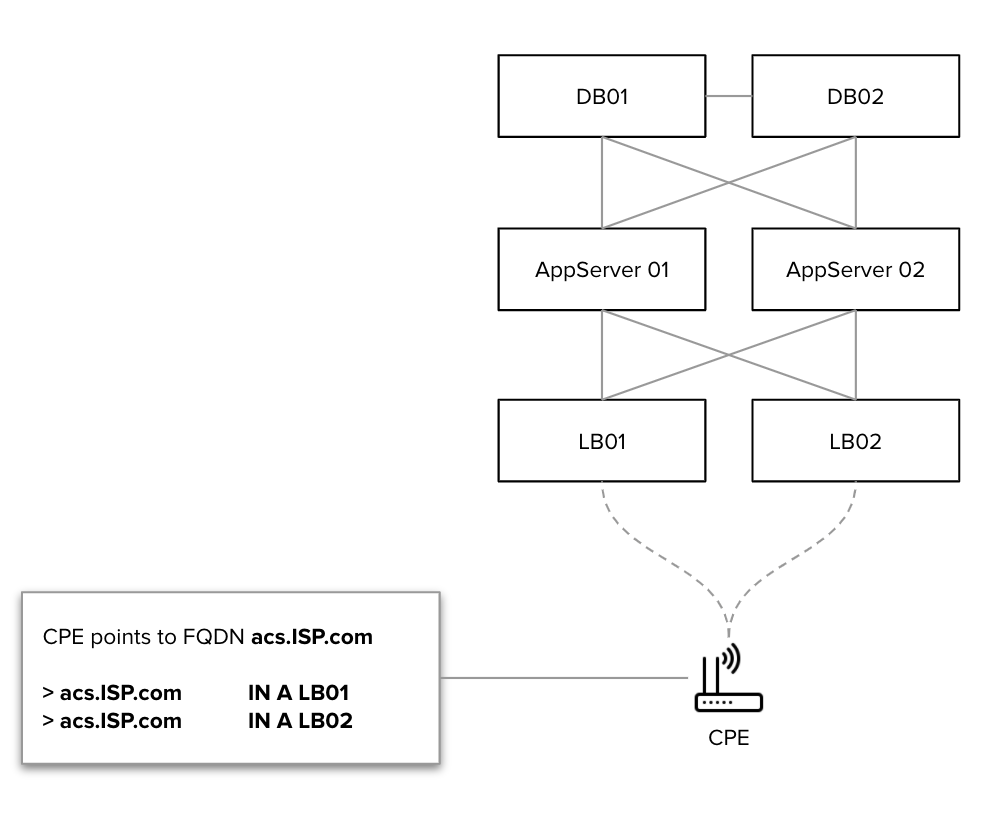
The standard CONTROL Device Management application architecture is illustrated below:
Architecture Prerequisites
The CONTROL HA architecture is designed with the following key requirements:
- Active-Active Configuration: Ensures predictable HA operation and optimal resource utilization
- Cluster Capacity: Each individual cluster must be capable of handling 100% of the average load
- Deployment Flexibility: HA clusters can be deployed either co-located or geographically distributed (typically requires site-to-site latency below 250 ms)
Principles of Operation
The HA architecture operates based on the following mechanisms:
- DNS Resolution: Customer Premises Equipment (CPE) points to a Fully Qualified Domain Name (FQDN) that resolves to the load balancer array
- DNS Health Checks: DNS periodically verifies load balancer array availability using HTTP health checks
- Load Balancer Health Checks: Load balancers periodically verify Auto Configuration Server (ACS) service availability through HTTP/API methods
Failure Scenarios
The following failure scenarios describe system behavior in a geographically-distributed HA deployment:
Complete Site or Load Balancer Failure
When DNS detects a failure, it automatically removes the failing load balancer from the DNS group, redirecting traffic to healthy sites.
Application Server Failure
When the load balancer detects an application server failure, it automatically removes the failing application server from the load balancer group, distributing traffic among remaining healthy servers.
Database Failure
In the event of a database failure, both application servers automatically fail over to the surviving database instance, ensuring continuous operation.
No comments to display
No comments to display