
Metric logs
Overview
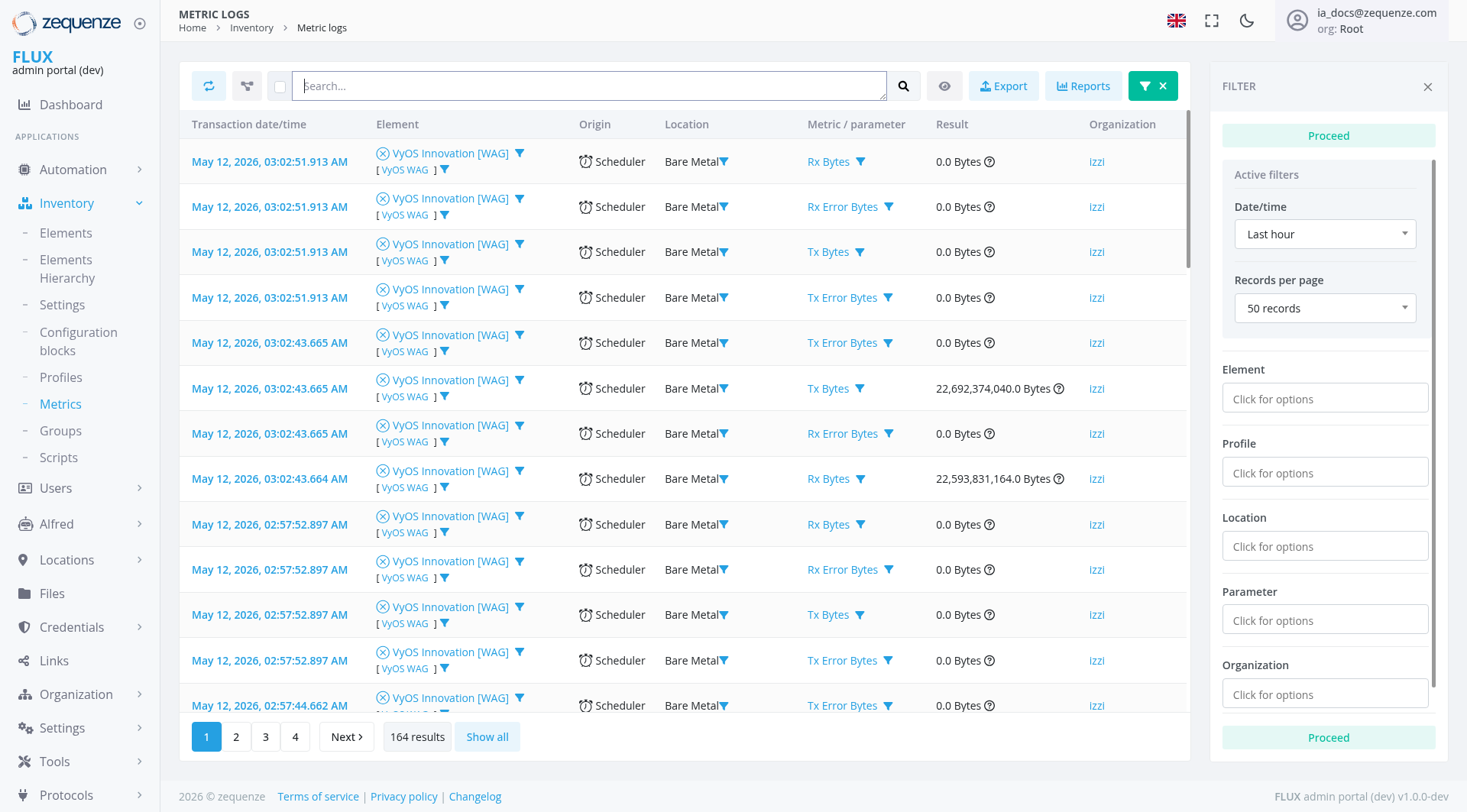
The Metric Logs page in the Zequenze FLUX Admin Portal provides a comprehensive view of all metric data collected from various devices and sensors in your fleet. This centralized logging system displays real-time and historical metric information, allowing administrators to monitor system performance, track data collection activities, and troubleshoot connectivity issues across their IoT infrastructure.
Key Features
- Real-time Metric Monitoring: View live data streams from connected devices and sensors
- Historical Data Access: Browse through timestamped metric logs with detailed filtering options
- Multi-parameter Tracking: Monitor various data types including network traffic metrics (Rx Bytes, Tx Bytes, Rx Error Bytes, Tx Error Bytes)
- Advanced Filtering: Filter logs by date/time, element, location, profile, parameter, and organization
- Data Export Capabilities: Export metric data for external analysis and reporting
- Pagination Support: Navigate through large datasets efficiently with pagination controls
UI Elements
Main Data Table
The central table displays metric logs with the following columns:
- Transaction date/time: Timestamp of when the metric was recorded (May 12, 2026 format with precise timestamps)
- Element: Device or sensor identifier (shows VyOS Innovation [WAG] devices with VyOS WAG configuration)
- Origin: Source of the data collection (Scheduler)
- Location: Physical or logical location of the device (Bare Metal)
- Metric/Parameter: Type of operation being tracked (Rx Bytes, Tx Bytes, Rx Error Bytes, Tx Error Bytes)
- Result: Actual metric values showing numerical results (0.0 Bytes, 22,692,374,040.0 Bytes, 22,593,831,164.0 Bytes) with information icons
- Organization: Associated organization (Izzi)
Filter Panel (Right Sidebar)
The filter panel is positioned on the right side with the following elements:
- Active Filters: Shows currently applied filters with "Proceed" status indicator at the top
- Date/Time Filter: "Last hour" dropdown selection
- Records Per Page: Set to "50 records" with dropdown options
- Element Filter: "Click for options" dropdown
- Profile Filter: "Click for options" dropdown
- Location Filter: "Click for options" dropdown
- Parameter Filter: "Click for options" dropdown
- Organization Filter: "Click for options" dropdown
- Proceed Button: Green "Proceed" button at the bottom to apply selected filters
Top Navigation Bar
User Interactions
Viewing Metrics
- Users can scroll through the paginated list of metric entries
- Click on column headers to sort data by specific criteria
- Use the pagination controls at the bottom (1, 2, 3, 4, Next, showing "164 results" with "Show all" option) to navigate through results
- Click the refresh button to reload the latest metric data
Filtering Data
- Access the filter panel by clicking the green filter button on the right side
- Select specific time ranges using the Date/Time dropdown
- Choose specific elements, profiles, locations, or parameters from their respective dropdowns
- Click the green "Proceed" button at the bottom to apply selected filters
- Apply multiple filters simultaneously for refined results
- Use the 'X' button in the top-right corner to close the filter panel
Data Export
- Click the blue "Export" button to download filtered metric data
- Select from available export formats for external analysis
Navigation
Accessing the Page
Related Pages
- Dashboard: Return to main overview
- Inventory: Access other inventory management features
- Elements: Manage individual device configurations
- Settings: Configure metric collection parameters
- Configuration blocks: Configure metric collection rules
- Profiles: Manage device profiles
- Groups: Organize elements into groups
- Scripts: Automate metric collection
- Locations: Manage location settings
- Credentials: Configure authentication for devices
Data Displayed
Metric Types
The system tracks network traffic metrics across devices:
- Rx Bytes: Bytes received by network interfaces
- Tx Bytes: Bytes transmitted by network interfaces
- Rx Error Bytes: Error bytes encountered during reception
- Tx Error Bytes: Error bytes encountered during transmission
Device Integration
The system tracks metrics from various infrastructure elements including:
- VyOS Innovation [WAG]: VyOS WAG network devices deployed on Bare Metal infrastructure
Data Values
The system tracks metrics with:
- Numerical Results: Values like 0.0 Bytes, 22,692,374,040.0 Bytes displayed with information icons providing additional context
- Network Traffic Data: Tracking bytes transmitted and received across network interfaces
- Error Monitoring: Separate tracking of error bytes for both transmission and reception
Temporal Data
- All entries are timestamped with precise date and time information
- Data spans multiple time periods for historical analysis
- Recent entries from May 12, 2026 are displayed with timestamps ranging across different time periods
Actions Available
Primary Actions
- Refresh Data: Click the refresh button to reload the latest metric information
- Filter Metrics: Apply various filters to narrow down displayed data using the green filter button
- Export Data: Download metric information for external use using the blue export button
- Generate Reports: Create formatted reports from selected metrics using the blue reports button
- Search Records: Use the search function with magnifying glass icon to find specific entries
- Paginate Results: Navigate through large datasets using page controls (1, 2, 3, 4, Next) or click "Show all" to view all 164 results
- Toggle View Options: Use the eye icon to adjust viewing preferences
Administrative Actions
- Monitor Real-time Data: View live metric updates as they occur
- Analyze Trends: Compare historical data across different time periods
- Track Network Traffic: Monitor network transmission and reception activities across the infrastructure
- Error Monitoring: Track network errors and transmission issues
- Organization Management: Filter data by organization
Notes/Tips
Performance Optimization
- Use specific filters to reduce large dataset load times
- Consider exporting data for complex analysis rather than processing in-browser
- The default "Last hour" filter helps focus on recent activity
- Use the refresh button to ensure you're viewing the most current data
Data Interpretation
- 0.0 Bytes Results: May indicate no network traffic during the measurement period or inactive interfaces
- Large Byte Values: High transmission values (e.g., 22+ billion bytes) indicate significant network activity
- Information Icons: Hover over or click the information icons next to numerical results for additional context
- Error Bytes: Non-zero error values may indicate network issues requiring attention
Best Practices
- Regularly monitor network traffic metrics to maintain system performance and identify bottlenecks
- Use the organization filter when managing multi-tenant environments
- Export historical data periodically for long-term trend analysis and network capacity planning
- Monitor both transmitted and received bytes to understand bidirectional traffic patterns
- Track error bytes to identify and resolve network issues promptly
- Monitor traffic across Bare Metal infrastructure to ensure optimal network performance
- Use filters to focus on specific network devices or time periods for targeted analysis
No comments to display
No comments to display