
Automation tasks
Overview
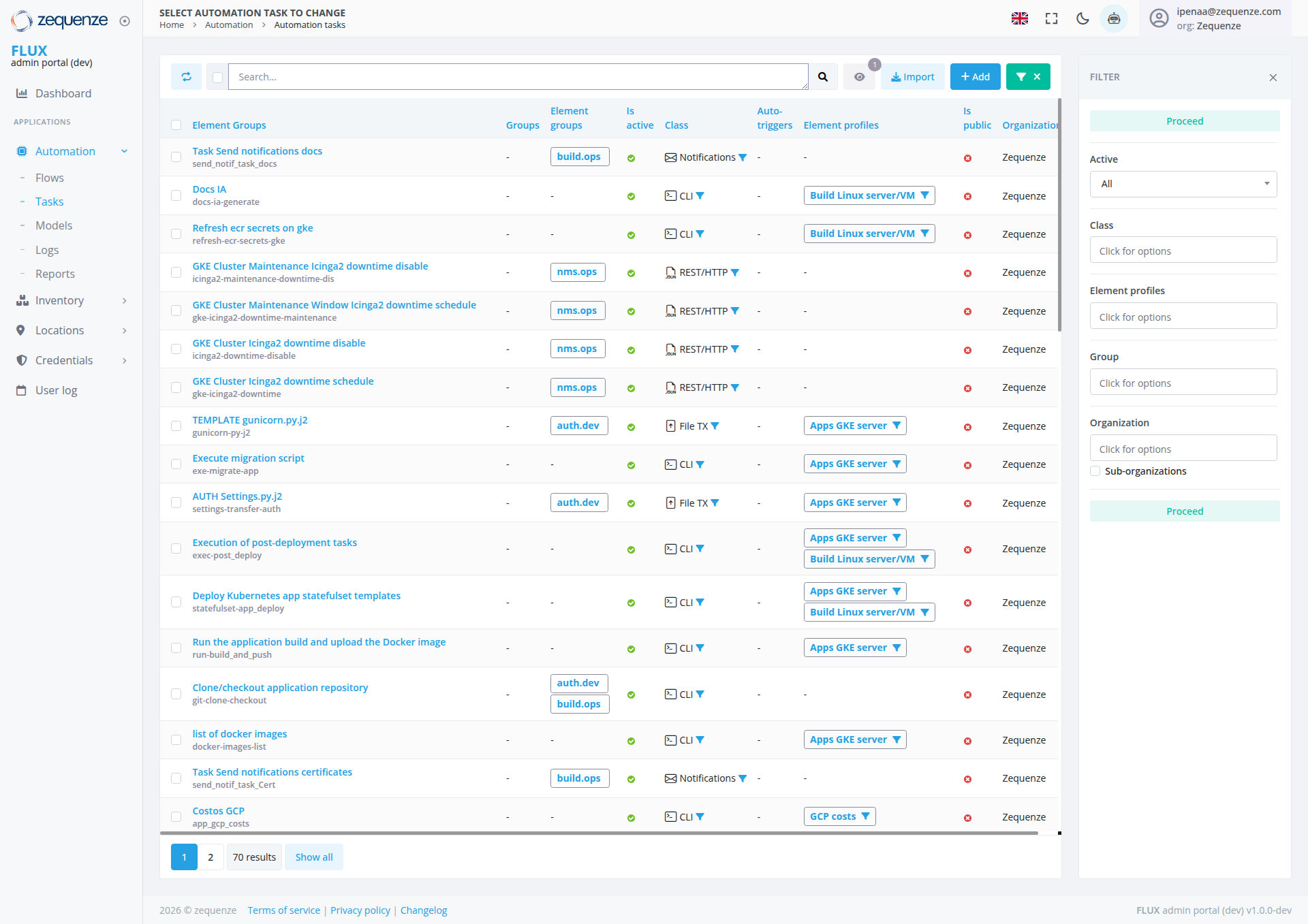
The Automation Tasks page in the Zequenze CONTROL Portal provides a comprehensive interface for managing and monitoring automated tasks across your network infrastructure. This page displays a detailed list of all automation tasks including documentation management, GKE cluster maintenance, Kubernetes deployments, and Docker image builds.
Key Features
- Task Management Dashboard: Centralized view of all automation tasks with real-time status monitoring
- Multi-Device Support: Handles various device types and infrastructure components
- Profile-Based Configuration: Tasks are organized by element profiles for efficient management
- Bulk Operations: Import and add multiple tasks simultaneously
- Advanced Filtering: Filter tasks by status, organization, class, and element profiles
- Real-time Status Tracking: Visual indicators show task execution status and health
UI Elements
Header Section
- Search Bar: Located at the top for quick task filtering and discovery
-
Action Buttons:
- Refresh Icon: Circular refresh button on the far left for reloading the task list
- Visibility Icon: Eye icon with notification badge showing "0" for toggling task visibility options
- Import: Blue button with user icon for importing task configurations
- Add: Green "+" button for creating new automation tasks
- Filter Toggle: Green dropdown button with "X" icon to show/hide filter panel
Main Task Table
The table displays the following columns:
- Checkbox Column: Select individual tasks for bulk operations
- Element Groups: Shows task categorization and grouping
- Groups: Primary task organization
- Element groups: Secondary grouping level
- Is active: Indicates if the task is currently active (green checkmarks visible)
- Class: Task classification (CLI, Notifications, REST/HTTP, File TX)
- Auto-triggers: Automated trigger rules applied
- Element profiles: Associated profiles (Build Linux server/VM, Apps GKE server, etc.)
- Is public: Visibility status of the task (red icons visible for private tasks)
- Organization: Organization assignment (Zequenze)
- Proceed: Task execution status (Active)
Filter Panel (Right Side)
The filter panel shows the following filtering options:
- Proceed: Filter section at the top with "Active" status display
- Class: "All" dropdown for filtering by task classification
- Element profiles: "Click for options" dropdown for profile-specific filtering
- Group: "Click for options" dropdown for task group filtering
- Organization: "Click for options" dropdown for organization-based filtering with "Sub-organizations" checkbox option below
User Interactions
Task Management
- Select Tasks: Use checkboxes to select individual tasks for bulk operations
- View Tasks: Browse through paginated list of automation tasks
- Search Tasks: Use the search bar to find specific tasks by name or description
- Refresh Tasks: Click the refresh icon to reload the current task list
- Toggle Visibility: Use the eye icon to adjust task visibility settings
- Filter Tasks: Apply multiple filters to narrow down task visibility
- Import Tasks: Bulk import automation tasks from external sources
- Add New Tasks: Create individual automation tasks using the Add button
Task Configuration
- Profile Selection: Tasks can be assigned to specific element profiles (Build Linux server/VM, Apps GKE server, etc.)
- Organization Assignment: Tasks can be assigned to specific organizations
- Access Control: Configure public/private visibility for tasks
Navigation
Current Location
Related Sections
- Flows: Automation workflow management
- Tasks: Current section for task management
- Models: Device and configuration models
- Logs: Task execution history
- Reports: Automation reporting and analytics
Data Displayed
Task Categories Visible
-
Documentation Tasks:
- Task Send notifications docs (send_notif_task_docs) - build.ops group
- Docs IA (docs-ia-generate)
-
GKE Cluster Maintenance:
- Refresh ecr secrets on gke (refresh-ecr-secrets-gke)
- GKE Cluster Maintenance icinga2 downtime disable (icinga2-maintenance-downtime-dis) - nms.ops group
- GKE Cluster Maintenance Window icinga2 downtime schedule (gke-icinga2-downtime-maintenance) - nms.ops group
- GKE Cluster icinga2 downtime disable (icinga2-downtime-disable) - nms.ops group
- GKE Cluster icinga2 downtime schedule (gke-icinga2-downtime) - nms.ops group
-
Template Management:
- TEMPLATE gunicorn.py.j2 (gunicorn-py-j2) - auth.dev group
-
Deployment & Migration:
- Execute migration script (exe-migrate-app)
- AUTH Settings.py.j2 (settings-transfer-auth) - auth.dev group
- Execution of post-deployment tasks (exec-post_deploy)
-
Kubernetes Operations:
- Deploy Kubernetes app statefulset templates (statefulset-app_deploy)
- Run the application build and upload the Docker image (run-build_and_push)
-
Additional Tasks:
- Clone/checkout application repository (git-clone-checkout) - auth.dev and build.ops groups
- list of docker images (docker-images-list)
- Task Send notifications certificates (send_notif_task_Cert) - build.ops group
- Costos GCP (app_gcp_costs)
Status Indicators
- Green Checkmarks: Indicate active/healthy tasks in the "Is active" column
-
Class Icons: Show different task types:
- Notifications icon (envelope) for notification tasks
- CLI icon (terminal) for command-line interface tasks
- REST/HTTP icon for API-based tasks
- File TX icon for file transfer tasks
- Profile Dropdowns: Display assigned element profiles with dropdown arrows including "Build Linux server/VM", "Apps GKE server", "GCP costs", and "CLI" configurations
- Organization Labels: Show task ownership (all tasks assigned to Zequenze)
- Red Icons: Indicate private tasks in the "Is public" column
- Proceed Status: All visible tasks show "Active" status
Actions Available
Primary Actions
- Select Tasks: Use checkboxes in the leftmost column to select individual tasks for bulk operations
- Refresh: Reload the task list to see latest updates
- Toggle Visibility: Control which tasks are displayed using the eye icon (with notification count badge)
- Import Tasks: Bulk import automation configurations
- Add Task: Create new automation task
- Filter Tasks: Apply various filtering criteria including class and element profiles
- Search Tasks: Quick search functionality
Secondary Actions
- Profile Management: Assign and modify element profiles including GKE server, Linux server/VM, and GCP costs profiles
- Organization Assignment: Change task ownership
- Status Management: Monitor and control task execution
- Pagination: Navigate through multiple pages of results (currently showing page 1 with 70 total results and "Show all" option available)
Notes/Tips
- Task Selection: Use the checkboxes to select multiple tasks for bulk operations
- Element Profile Matching: Ensure tasks are assigned to appropriate element profiles for successful execution, including Apps GKE server, Build Linux server/VM, and GCP costs profiles
- Organization Permissions: Task visibility and execution may be restricted based on organization membership
- Status Monitoring: Green checkmarks in the "Is active" column represent healthy/active tasks - monitor for any status changes
- Pagination: Use page navigation to view all 70 automation tasks or click "Show all" to display all results at once
- Filter Combinations: Multiple filters can be applied simultaneously for precise task management - filters are arranged vertically starting with Proceed status at the top
- Task Naming: Tasks follow a structured naming convention with technical identifiers in parentheses for easy identification
- Cloud Infrastructure: Multiple tasks are dedicated to GKE cluster maintenance and Kubernetes deployments
- Class Filtering: The "All" dropdown in the Class filter allows you to narrow tasks by their type (CLI, REST/HTTP, Notifications, File TX)
- Notification Badge: The eye icon displays a badge with "0" indicating the number of hidden or filtered tasks
No comments to display
No comments to display