
Automation models
Overview
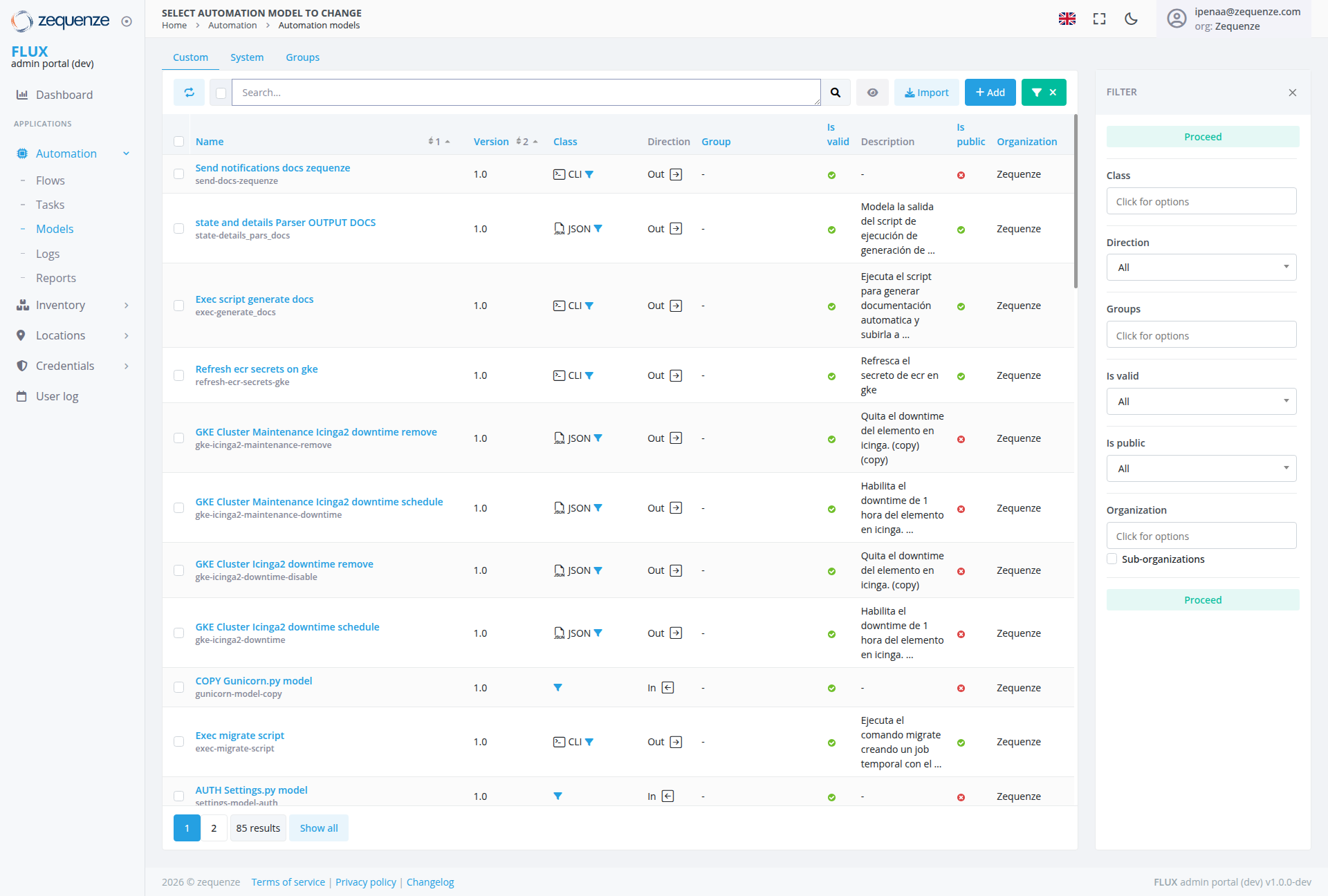
The Automation Models page in the Zequenze Control Portal provides a comprehensive interface for managing automation models within the FLUX admin portal. This page displays a detailed table of automation models with their configurations, versions, and operational status, allowing administrators to monitor and manage their automation infrastructure.
Key Features
- Model Management: View and manage all automation models in a centralized table
- Version Control: Track different versions of automation models
- Status Monitoring: Real-time status indicators showing model validity and public accessibility
- Organization Management: Models are organized by groups and organizations
- Filtering and Search: Advanced filtering options and search functionality with collapsible filter panel
- Bulk Operations: Import and add multiple models simultaneously
UI Elements
Navigation Bar
Tab Navigation
- Custom: Currently selected tab
- System: System-level automation models
- Groups: Group-based model organization
Action Buttons
- Refresh: Left-most circular arrow button for refreshing the model list
- Import: Blue button for importing automation models
- Add: Green plus button for adding new models
- X: Green close/clear button for clearing selections or filters
- FILTER: Filter toggle button with X close option (filter panel currently collapsed)
Filter Panel
The collapsible filter panel on the right side (currently collapsed) includes:
- Class: Dropdown selector with "Click for options" placeholder
- Direction: Dropdown with "All" selected
- Groups: Selection with "Click for options" placeholder
- Is valid: Dropdown with "All" selected
- Is public: Dropdown with "All" selected
- Organization: Dropdown with "Click for options" placeholder
- Sub-organizations: Additional organizational filtering option
- Proceed: Green "Proceed" button at the bottom of the filter panel
Main Data Table
The table contains the following columns:
- Name: Model names with descriptive identifiers (sortable with up/down arrows)
- Version # 2: Version numbers (mostly 1.0, sortable with up/down arrows)
- Class: Model classification (CLI, JSON) with dropdown indicators
- Direction: Data flow direction (Out, In) with directional arrows
- Group: Associated group indicator
- Is valid: Green checkmarks indicating model validity
- Description: Detailed descriptions of model functionality in Spanish
- Is public: Red/Green indicators showing public accessibility status
- Organization: All models shown belong to "Zequenze"
Displayed Models
The table shows several automation models:
- Send notifications docs zequenze (send-docs-zequenze) - CLI, version 1.0, Out direction
- state and details Parser OUTPUT DOCS (state-details_pars_docs) - JSON, version 1.0, Out direction
- Exec script generate docs (exec-generate_docs) - CLI, version 1.0, Out direction
- Refresh ecr secrets on gke (refresh-ecr-secrets-gke) - CLI, version 1.0, Out direction
- GKE Cluster Maintenance icinga2 downtime remove (gke-icinga2-maintenance-remove) - JSON, version 1.0, Out direction
- GKE Cluster Maintenance icinga2 downtime schedule (gke-icinga2-maintenance-downtime) - JSON, version 1.0, Out direction
- GKE Cluster icinga2 downtime remove (gke-icinga2-downtime-disable) - JSON, version 1.0, Out direction
- GKE Cluster icinga2 downtime schedule (gke-icinga2-downtime) - JSON, version 1.0, Out direction
- COPY Gunicorn.py model (gunicorn-model-copy) - version 1.0, In direction
- Exec migrate script (exec-migrate-script) - CLI, version 1.0, Out direction
- AUTH Settings.py model (settings-model-auth) - version 1.0, In direction
User Interactions
Search and Filter
- Search Bar: Located at the top with magnifying glass icon for quick model searches
- Refresh Button: Circular arrow icon to refresh the model list and reload data
- Collapsible Filter Panel: "FILTER" button toggles the detailed filter panel on the right side, currently showing collapsed state
- Filter Options: Multiple dropdown selectors for Class, Direction, Groups, validation status, public status, and organization filtering (accessible when expanded)
- Filter Application: Green "Proceed" button to apply selected filter criteria
Table Interactions
- Sorting: Column headers for "Name" and "Version" are clickable for sorting (indicated by up/down arrows)
- Row Selection: Checkboxes for selecting individual models
- Pagination: Bottom navigation shows "1 2 85 results" with "Show all" option
Navigation
Access Path
Users can reach this page through:
Related Sections
- Dashboard: Main dashboard access
-
Automation: Currently active section (expanded)
- Flows: Automation workflow management
- Tasks: Task management
- Models: Currently active section
- Logs: System logs
- Reports: Automation reports
- Inventory: Inventory management
- Locations: Location management
- Credentials: Credential management
- User log: User activity logs
Data Displayed
Model Types
The page displays various automation model types:
- Documentation Models: Models for sending notifications and generating documentation
- Parser Models: Output document parsing models
- Script Execution Models: Automated script generation and execution (generate docs, migrate script)
- Cloud Infrastructure Models: GKE cluster management and ECR secret refresh models
- Monitoring Integration Models: Icinga2 downtime scheduling and maintenance models
- Application Configuration Models: Gunicorn and AUTH settings models
Status Indicators
- Green Checkmarks: Valid models ready for use (shown in "Is valid" column)
- Red/Green Circles: Models with different public accessibility status (shown in "Is public" column)
- Version Numbers: Track model evolution and updates
- Direction Indicators: Show data flow direction (Out, In) with corresponding arrow icons
Actions Available
Primary Actions
- Refresh Models: Click the circular arrow button to reload the model list and update data
- Import Models: Bulk import automation models from external sources
- Add New Model: Create new automation models
- Clear/Close: Green X button for clearing selections or closing panels
- Toggle Filters: Use the "FILTER" button to show/hide the detailed filtering panel
Filtering Actions
- Advanced Filtering: Expand the filter panel to filter by Class, Direction, Groups, validation status, public accessibility, and organization
- Multi-criteria Filtering: Apply multiple filters simultaneously using the dropdown selectors in the filter panel
- Apply Filters: Use the green "Proceed" button to execute the selected filter criteria
Model-Specific Actions
- View Details: Click on model names to view detailed configurations
- Version Management: Track and manage different model versions using sortable Version column
- Status Updates: Monitor and update model validity status
- Sort Models: Click on "Name" or "Version" column headers to sort models
Notes/Tips
Best Practices
- Regular Monitoring: Check the "Is valid" column regularly to ensure models are functioning correctly
- Version Control: Keep track of version numbers when updating models, using the sortable Version column for easy comparison
- Organization: Use the collapsible filter panel to efficiently manage large numbers of models without cluttering the interface
- Filter Management: Expand the filter panel, utilize the detailed filter options, and click "Proceed" to apply multiple criteria for narrowing down results
- Data Refresh: Use the refresh button to ensure you're viewing the most current model data
Important Information
- Pagination: With 85 total results, use pagination or the advanced filtering options to manage large datasets effectively
- Model Validation: Indicators in the "Is public" column show different accessibility statuses requiring attention
- Search Optimization: Use the search functionality to quickly locate specific models by name or description
- Filter Workflow: Expand the filter panel, select desired filter criteria from the dropdowns, and click the "Proceed" button to apply filters effectively
- Language Support: Model descriptions are displayed in Spanish, indicating multi-language support
- Direction Types: Models can have different directions (In/Out) indicating their data flow pattern
Footer Information
- Copyright: 2026 © zequenze
- Legal Links: Terms of service, Privacy policy, and Changelog available
- Version: FLUX admin portal (dev) v1.0.0-dev
No comments to display
No comments to display