Results: New accounting sessions
Generating documentation...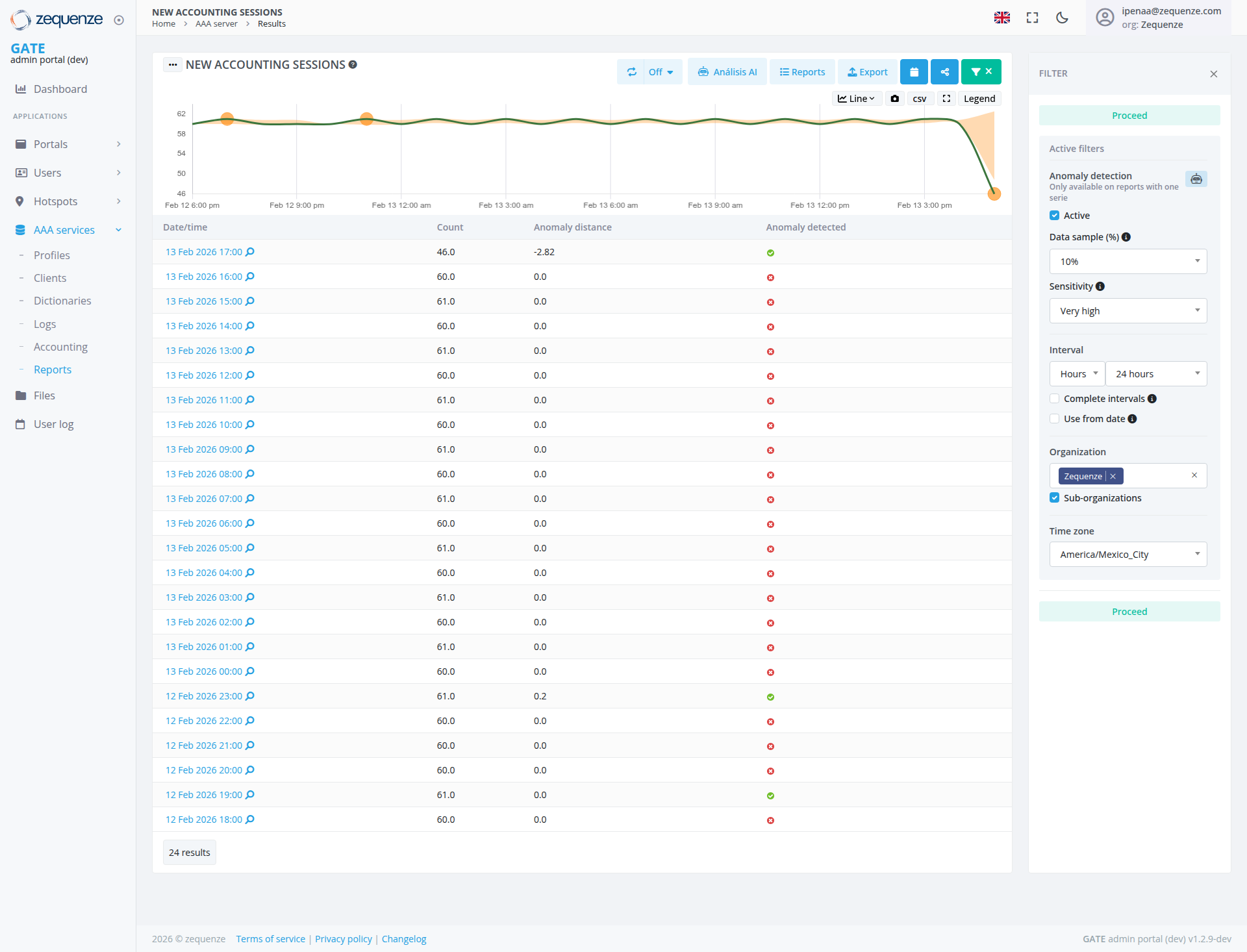
Overview
The NEW ACCOUNTING SESSIONS report in the GATE admin portal provides comprehensive monitoring and anomaly detection for AAA (Authentication, Authorization, and Accounting) server sessions. This page displays time-series data with advanced analytics capabilities, allowing administrators to track session counts, identify anomalies, and analyze patterns over time.
Key Features
Real-time Session Monitoring: Visualizes accounting session data with interactive line graphs showing session counts over time
Anomaly Detection: Automated detection system that identifies unusual session patterns and flags them with distance metrics
Time-series Analysis: Displays historical session data with customizable time intervals
Multi-organization Support: Includes sub-organization filtering capabilities
Export Functionality: Allows data export for external analysis and reporting
Configurable Sensitivity: Adjustable anomaly detection parameters for fine-tuned monitoring
UI Elements
Top Action Bar
Refresh Button (circular arrows): Reloads the report data
Off Toggle: Controls report auto-refresh status
Análisis AI: Accesses AI-powered analysis features
Reports: Navigation to other report types
Export: Exports data in various formats
Save Button (bookmark icon): Saves current report configuration
Share Button: Shares report with other users
Filter Toggle (green checkmark): Opens/closes the filter panel
Display Options:
Line chart view
CSV export
Legend toggle
Filter Panel (Right Sidebar)
Anomaly Detection Settings
Active: Checkbox to enable/disable anomaly detection (currently checked)
Data sample (%): Dropdown set to "10%" - controls the percentage of data used for analysis
Sensitivity: Dropdown set to "Very high" - adjusts the threshold for anomaly detection
Time Configuration
Interval: Set to "Hours" with "24 hours" selected - defines the time window for data aggregation
Complete intervals: Checkbox option for interval boundary alignment
Use from date: Checkbox for custom date range selection
Organization Filters
Organization: Shows "Zequenze" tag with an "X" for removal
Sub-organizations: Checkbox (checked) to include data from sub-organizations
Time Zone
Time zone: Dropdown showing "America/Mexico_City" - sets the timezone for all timestamps
Main Chart Area
The line graph displays:
X-axis: Date/time stamps (Feb 12 6:00 pm through Feb 13 3:00 pm)
Y-axis: Session count (scale from 48 to 172)
Yellow warning markers: Indicate detected anomalies on the timeline
Trend line: Shows session count progression over time with visible anomaly spike at the end
Data Table
Columns include:
Date/time: Timestamp with clickable link icon for drill-down
Count: Session count value (ranging from 46.0 to 61.0)
Anomaly distance: Numeric value showing deviation from normal (-2.82 to 0.2)
Anomaly detected: Visual indicator (green checkmark or red dot)
User Interactions
Viewing Session Data
The chart automatically displays session trends based on active filters
Hover over data points on the line graph to see detailed values
Click on timestamps in the table to view session details
Scroll through the table to review all 24 results
Applying Filters
Click the FILTER button in the top-right to open the filter panel
Adjust anomaly detection parameters:
Toggle "Active" to enable/disable detection
Modify "Data sample (%)" for analysis depth
Change "Sensitivity" level (Very high, High, Medium, Low)
Set time interval preferences (hours, days, weeks, months)
Select organization and include/exclude sub-organizations
Choose appropriate timezone for data display
Click Proceed to apply changes
Analyzing Anomalies
Review rows marked with red dots in the "Anomaly detected" column
Check "Anomaly distance" values - higher absolute numbers indicate greater deviation
Yellow warning markers on the chart highlight time periods with detected anomalies
The chart shows a significant spike at approximately Feb 13 3:00 pm
Exporting Data
Click the Export button in the top toolbar
Choose between:
Line chart view for visual export
CSV format for raw data export
Click Legend to include/exclude legend in exports
Navigation
Accessing This Page
From the left sidebar:
Navigate to APPLICATIONS section
Expand AAA services
Select Accounting
Click on Reports
Breadcrumb Navigation
Located at the top: Home > AAA server > Results
Profiles: User profile management
Clients: AAA client configuration
Dictionaries: Attribute definitions
Logs: Detailed logging information
Files: File management for configurations
Data Displayed
Session Metrics
Count: Total number of accounting sessions in each time interval
Date/time: Precise timestamp for each data point
Anomaly distance: Statistical measure of deviation from expected values (negative values indicate below-normal activity, positive values indicate above-normal)
Anomaly Indicators
Green checkmark: Normal session activity within expected parameters
Red dot: Anomaly detected based on configured sensitivity and window size
Yellow markers: Visual alerts on the timeline chart
Current Data Set
The report shows 24 results spanning from 12 Feb 2026 18:00 to 13 Feb 2026 17:00, with:
Most sessions showing 60.0-61.0 count
One notable anomaly at 17:00 with -2.82 distance and 46.0 count
Another anomaly at 23:00 with 0.2 distance and 61.0 count
Actions Available
Primary Actions
Proceed: Applies current filter configuration and refreshes data
Análisis AI: Launches AI-powered analysis tools for deeper insights
Export: Downloads report data in selected format
Share: Distributes report to team members or stakeholders
Save: Preserves current view configuration for future use
Data Management
Refresh: Manually updates the report with latest data
Toggle Auto-refresh: Enables/disables automatic data updates
Clear Filters: Removes active filters by clicking "X" on filter tags
Drill-down Capabilities
Click on any timestamp link (blue link with arrow icon) to view detailed session information
Access individual session records for troubleshooting and analysis
Notes/Tips
Best Practices
Sensitivity Settings: Start with "Very high" sensitivity to catch all potential anomalies, then adjust based on false positive rates
Data Sampling: 10% sample size is suitable for large datasets; increase for more precise anomaly detection on smaller datasets
Time Intervals: 24-hour intervals provide good balance between detail and overview for most monitoring scenarios
Interpreting Anomalies
Negative anomaly distance: Indicates unusually low session counts (potential service issues)
Positive anomaly distance: Indicates unusually high session counts (potential security events or legitimate traffic spikes)
Zero distance: Sessions within normal expected range
Enable "Sub-organizations" only when cross-organizational analysis is required
Use appropriate time intervals to balance detail vs. system performance
Export to CSV for complex analysis in external tools like Excel or data analysis platforms
Troubleshooting
If no anomalies appear but issues are suspected, lower the sensitivity setting
Verify timezone settings match your operational requirements
Check that the "Active" checkbox is enabled for anomaly detection to function
Ensure "Zequenze" organization filter is correctly applied for relevant data
URL Parameters
The page URL contains several parameters that define the current view:
visualization_type=line: Display mode
organization__in=2: Organization ID filter
suborgs=1: Sub-organizations included
interval=24h: 24-hour time intervals
anomaly=1: Anomaly detection enabled
window=10: Detection window size
sigma=1: Statistical sensitivity parameter
