Elements

Screenshot - ElementsScreenshot - Elements

Overview

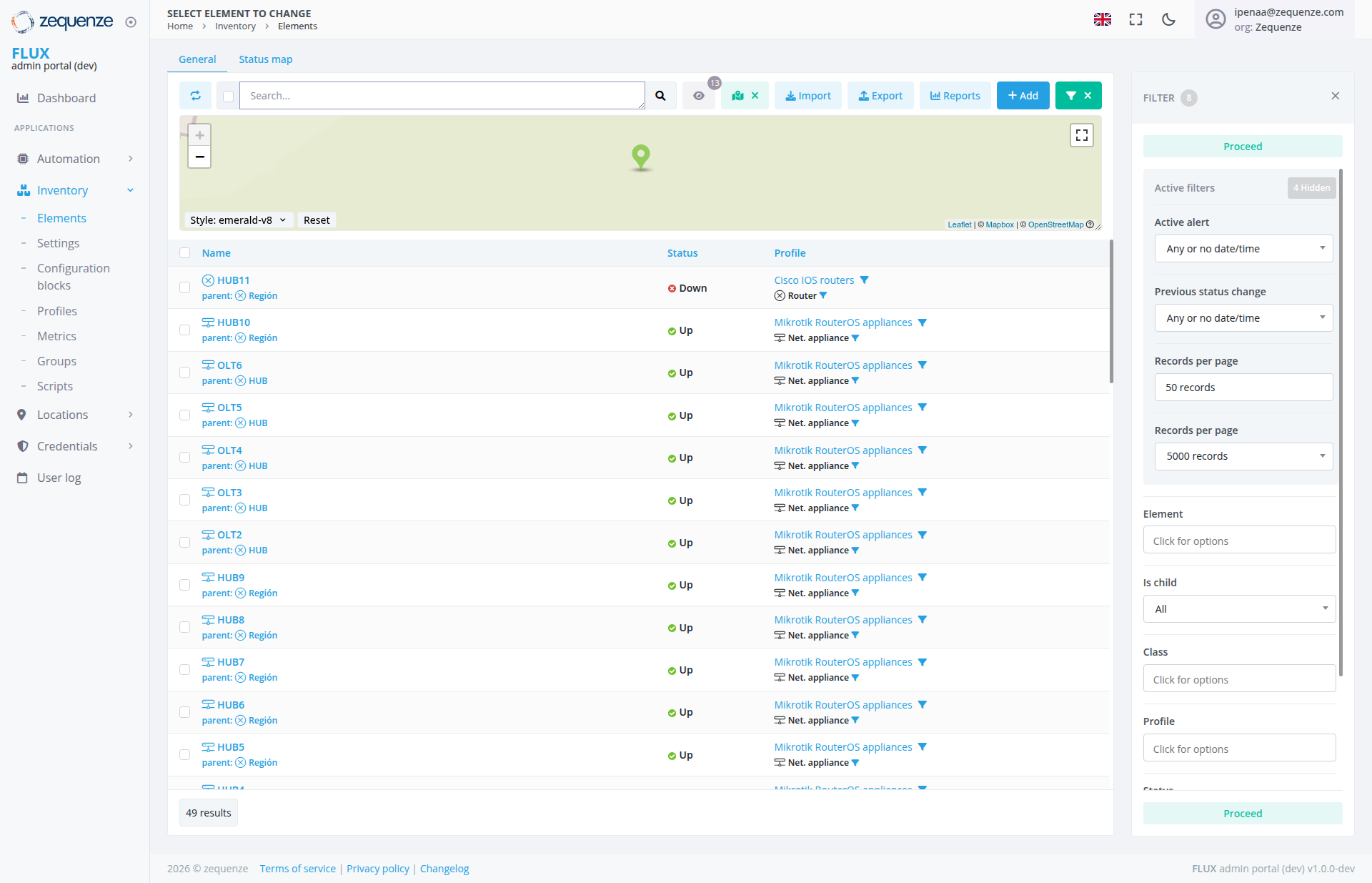
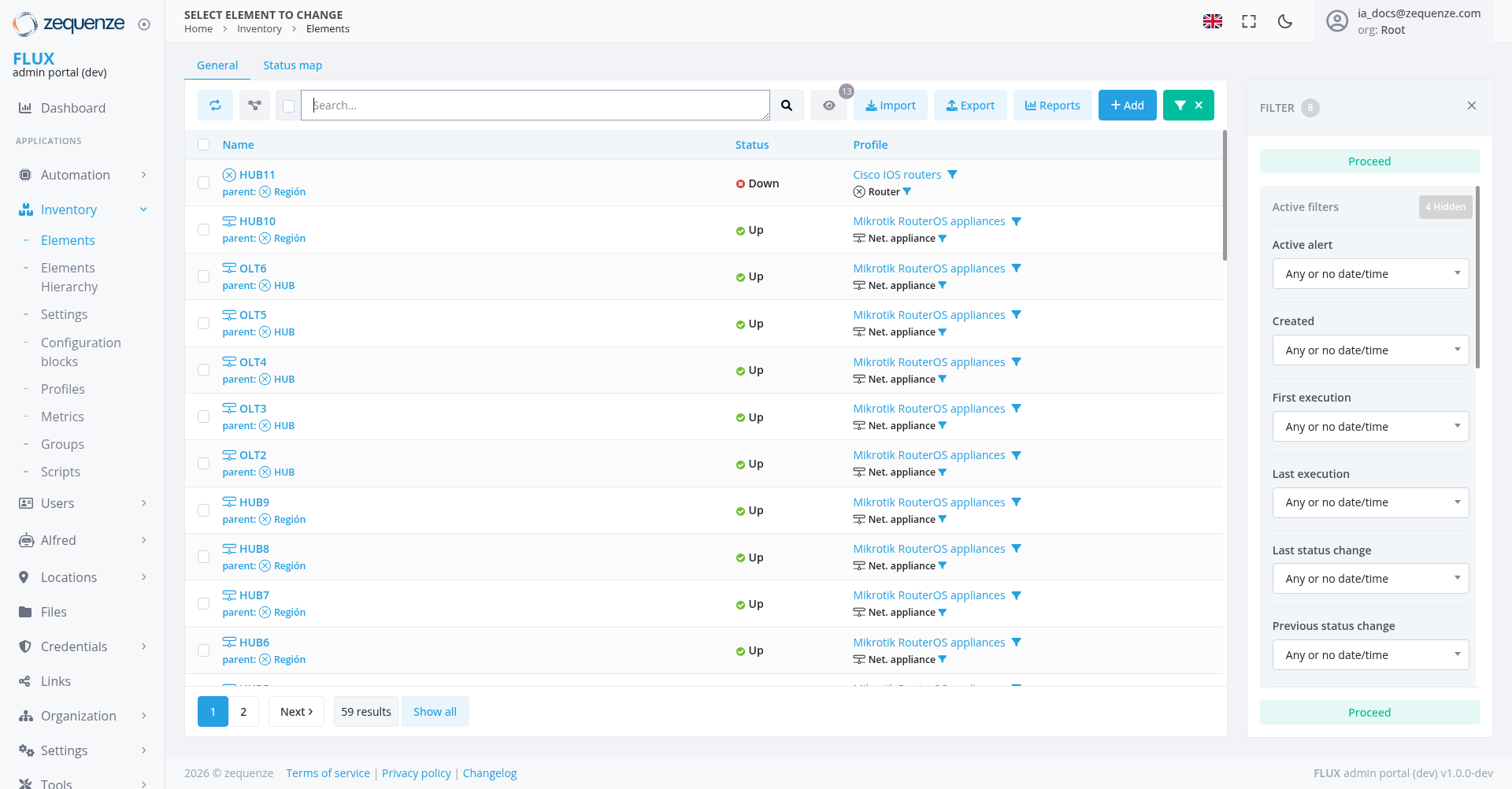
The Inventory Elements page in the Zequenze CONTROLFLUX Portal provides a comprehensive view of all network elements and devices managed within the system. This centralized dashboard allows administrators to monitor device status, manage configurations, and perform various operations on network infrastructure components.

Key Features

  • Real-time Status Monitoring: View current operational status of all network elements
  • Interactive Map View: Visual representation of device locations with status indicators
Advanced Filtering: Multiple filter options to quickly locate specific elements Bulk Operations: Import, export, and manage multiple elements simultaneously Status Tracking: Monitor changes in device states over time Profile Management: View and manage device profiles and configurations

UI Elements

Navigation Bar

  • HomeInventoryElements breadcrumb navigation
  • Language selector (English flag icon)
  • User profile indicator showing logged-in user (ipenaa@zequenze.la_docs@zequenze.com)
  • Organization context (org: Zequenze)Root)

Tab Navigation

  • General: Current active tab showing element listing
  • Status map: Tab for geographical distribution view

Search and Filter Controls

  • Search Bar: Text-based search functionality for finding specific elements
  • View Mode Toggle: Toggle with "1" indicator for viewing options
Location Filter: Map pin icon button for location-based filtering Import Button: Upload element configurations from external files Export Button: Download element data and configurations Reports Button: Generate reports on element status and performance Add Button (+): Create new network elements X Button: Clear current filters or selections Filter Panel: Advanced filtering options on the right side with "Proceed" button

Map View

    Interactive map with green location markers showing device locations Style selector (currently set to "emerald-v8") Reset button to restore default map view Zoom controls (+ and - buttons) Fullscreen toggle option Map powered by Leaflet | © Mapbox | © OpenStreetMap

    Data Displayed

    The main table shows detailed information about network elements:

    Column Structure

    • Name: Element identifier with clickable links and parent information
    • Status: Current operational state (Up/Down with colored indicators)
    • Profile: Associated device profile and type information with expandable details

    Element Types and Status

    The table displays various network elements including:

    • HUB11: Network hub (Status: Down) with parent: Región, using Cisco IOS routers Router profile
    • HUB10: Network hub (Status: Up) with parent: Región, using Mikrotik RouterOS appliances Net. appliance profile
    • OLT6, OLT5, OLT4, OLT3, OLT2: Optical Line Terminals (Status: Up) with parent: HUB, using Mikrotik RouterOS appliances Net. appliance profile
    • HUB9, HUB8, HUB7, HUB6, HUB5HUB6: Additional network hubs (Status: Up) with parent: Región, using Mikrotik RouterOS appliances Net. appliance profile

    Parent-Child Relationships

    Elements display hierarchical relationships:

    • parent: label with linked parent element name and navigation icon (⊕)
    • Visual indication of element hierarchy within the network infrastructure

    Status Indicators

    • 🟢 Green dot: Element is operational (Up)
    • 🔴 Red dot: Element is down or experiencing issues
    • Profile badges: Show device categories with detailed profile information and expandable dropdown arrows (Router, Net. appliance, etc.)

    User Interactions

    Search and Discovery

    • Use the search bar to find elements by name or identifier
    Toggle view modes using the view mode button (showing "1" indicator) Apply location-based filters using the map pin icon Apply filters using the right-side filter panel Toggle between General and Status map views Clear filters using the X button Navigate parent-child relationships by clicking on parent links

    Element Management

    • Click on element names to access detailed configuration
    • Use bulk operations for managing multiple elements
    • Import/export configurations for backup or migration
    • Reset map view to default settings
    Expand profile information using dropdown arrows for detailed device specifications

    Status Monitoring

    • Monitor real-time status changes
    • View historical status information
    • Set up alerts for status changes

    Navigation

    Access Path

    Home → Inventory → Elements

    • Settings: Configure element parameters
    • Configuration blocks: Manage configuration templates
    • Profiles: Define device profiles
    • Metrics: View performance data
    • Groups: Organize elements into logical groups
    • Scripts: Automation and scripting tools
    • Locations: Manage device locations
    • Credentials: Access and authentication management
    • User log: Activity tracking and audit trail

    Actions Available

    Individual Element Actions

    • View Details: Click element name for detailed information
    • Edit Configuration: Modify element settings
    • Status Management: Monitor and troubleshoot connectivity
    • Expand Profile Details: Use dropdown arrows to view complete profile specifications
    • Navigate Hierarchy: Click parent links to view parent element details

    Bulk Operations

    • Import Elements: Upload multiple element configurations
    • Export Data: Download element information and configurations
    • Generate Reports: Create status and performance reports
    • Add New Elements: Create single or multiple network elements
    • Clear Filters: Use X button to reset current filter selections
    • Proceed: Execute batch operations on filtered results

    Map Controls

      Reset: Restore map to default view and settings Style Selection: Choose different map styles (emerald-v8 currently selected)

      Filtering Options

      • Active Filters: 4Tracking Hiddenand activemanagement of applied filters applied
      • View Mode: Toggle button with "1" indicator for different viewing options
      Location Filter: Map pin icon for geographical filtering Records per page: Currently set to 50 records display limit Status Filters: Filter by operational state Profile Filters: Filter by device type or profile Element Type: Filter by specific element categories

      Filter Panel Options

      The right-side filter panel provides advanced filtering capabilities:

      • FILTER header with close button (X) in the top-right corner
      • Proceed Button: Execute filtering operations on selected criteria (highlighted in green, appearing at the top and bottom of the panel)
      • Active filters: Shows "4All Hidden"hidden" indicatingwith multipleexpandable activemanagement filtersoptions
      • Active alert: Filter by alert status with "Any or no date/time" dropdown
      • Created: Filter by creation date with "Any or no date/time" dropdown
      PreviousFirst execution: Filter by timing of first execution with "Any or no date/time" dropdown Last execution: Filter by timing of last execution with "Any or no date/time" dropdown Last status change: Filter by timing of status changes with "Any or no date/time" dropdown Previous Recordsstatus per page: Set to 50 records with dropdown selector Records per page (secondary): Set to 5000 records option available Element: "Click for options" expandable menu for element selection Is childchange: Filter forby childtiming elementsof previous status changes with "All"Any or no date/time" dropdown selection Class: "Click for options" expandable menu for class-based filtering Profile: "Click for options" expandable menu for profile-based filtering

      Notes/Tips

      • Performance: The page shows 4959 results with configurablepagination record limitscontrols for optimal viewing
      • Real-time Updates: Status indicators provide live monitoring capabilities
      • Enhanced Filtering: Multiple activetime-based filters (4 Hidden) enable precise element selection withbased expandableon filterexecution panelhistory forand detailedstatus configurationchanges
      • Visual Feedback: Color-coded status indicators for quick assessment
      • Responsive Design: Map view can be expanded to fullscreen for better visibility, and filter panel can be expanded to show all available options
      Data Export: Use export functionality for reporting and backup purposes Advanced Filtering: Proceed button enables batch operations on filtered results and is highlighted in green for clear action identification Quick Reset: Use the X button to quickly clear active filters and the Reset button to restore default map view Filter Panel Management: The filter panel can be closed using the X button in the top-right corner to provide more screen space for the main content Flexible Pagination: Records per page can be adjusted using dropdown selectors for different viewing preferences Status Change Tracking: PreviousMultiple status change filterfilters enablesenable comprehensive monitoring of recent device state transitions over time Alert Management: Active alert filtering allows monitoring of elements with current alerts Detailed Profile Information: Expandable profile dropdown arrows provide access to comprehensive device specifications and classifications View Customization: Use the view mode toggle to switch between different data presentation formats Location-Based Filtering: The map pin icon provides quick access to geographical filtering options Hierarchical Navigation: Parent links with navigation icons enable quick traversal through the element hierarchy Execution MultipleHistory Filter CategoriesTracking: FilterFirst and last execution filters provide insight into element activity patterns Flexible Date Filtering: All time-based filters default to "Any or no date/time" for maximum flexibility Dual Proceed Actions: Proceed buttons at both top and bottom of filter panel includes Class and Profile options for moreconvenient granularaccess elementregardless selectionof scroll position