# Overview
# Architecture
## Overview
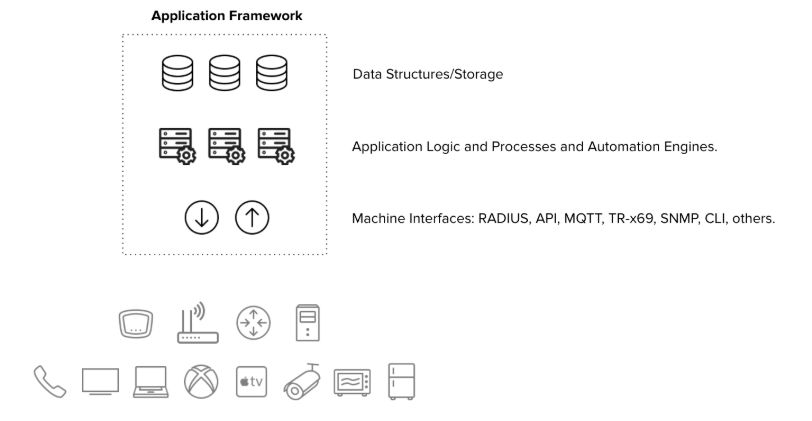
The CONTROL platform is built on Zequenze's core framework architecture, designed for scalability and performance. The system is organized into three main layers that work together to provide comprehensive device and service management capabilities.
## Architecture Layers
### Machine Interfaces
The interface layer handles all communication protocols and external connections:
- TR069
- MQTT
- Web Server
- Additional protocol adapters
### Application Layer
The application layer provides core management functionality:
- Device Management
- Service Management
- Firmware Manager
- Additional management applications
### Databases
The data layer stores and manages:
- Device records
- Metrics and telemetry data
- Configuration data
- Additional operational data
## Architecture Diagram
## Scalability
Each architectural layer can be scaled horizontally independently, allowing you to optimize resources based on specific requirements:
- **Traffic volume** – Scale interface layers to handle increased connection loads
- **Activity levels** – Scale application layers to process more operations
- **Data size** – Scale database layers to accommodate growing data storage needs
## Related Documentation
- [What is CONTROL?](https://docs.zequenze.com/books/control/page/what-is-control)
- [Specifications](https://docs.zequenze.com/books/control/page/specifications)
# Specifications
## Overview
CONTROL is a carrier-grade device management platform designed for service providers requiring comprehensive multi-vendor and multi-protocol device management capabilities.
## Platform Characteristics
### Carrier-Grade Architecture
- **Multi-protocol and multi-vendor support**: Enables management of diverse device ecosystems through multiple southbound protocols including TR-069, MQTT, SNMP, API, and CLI
- **Standards compliance**: Full adherence to Broadband Forum Device Management Specifications
- [CPE WAN Management Protocol](https://cwmp-data-models.broadband-forum.org/) ([TR-069 Amendment 6](https://www.broadband-forum.org/technical/download/TR-069_Amendment-6.pdf))
- **Cloud-native design**: Horizontally scalable cloud-based architecture for enterprise-grade performance
- **OSS/BSS integration**: Seamless integration with Service Provider operational and business support systems through flexible APIs
### Core Functionalities
**Device Lifecycle Management**
- Automated device onboarding
- Comprehensive firmware management
- Bulk provisioning capabilities
**Configuration Management**
- Device general information and configuration
- WAN technologies: LTE, GPON, Cable, DSL
- LAN and WiFi configuration
- CWMP protocol configuration
- Services configuration
- Configuration scripting and automation
**Diagnostics and Troubleshooting**
- TR-143 based device diagnostics
- Advanced CLI for technical troubleshooting
- Real-time device monitoring
### Scalable Database Architecture
- Integrated database for high-scale deployments supporting millions of device records
- Native database integration with optional support for external database systems
- Multiple device provisioning methods:
- Web-based GUI
- Bulk provisioning
- Auto-onboarding
- External API integration
### Flexible Management Interface
**Dual Access Methods**
- Intuitive web-based GUI for manual operations
- Comprehensive API for automation and integration
**Role-Based Access Control**
- Customizable privileges based on user and organization profiles
- Support for multiple user types: call center users, NOC operators, engineering staff
### Reports and Analytics
**Comprehensive Reporting**
- Device-based reports
- Location and group-based analytics
- Interactive heatmaps
**Data Analysis and Export**
- Historical metrics tracking for any device parameter
- Multiple export formats: CSV, API, and more
- Custom reporting capabilities
## Further Reading
- [What is CONTROL?](https://docs.zequenze.com/books/control/page/what-is-control)
- [Architecture](https://docs.zequenze.com/books/control/page/architecture)
# What is CONTROL?
## Overview
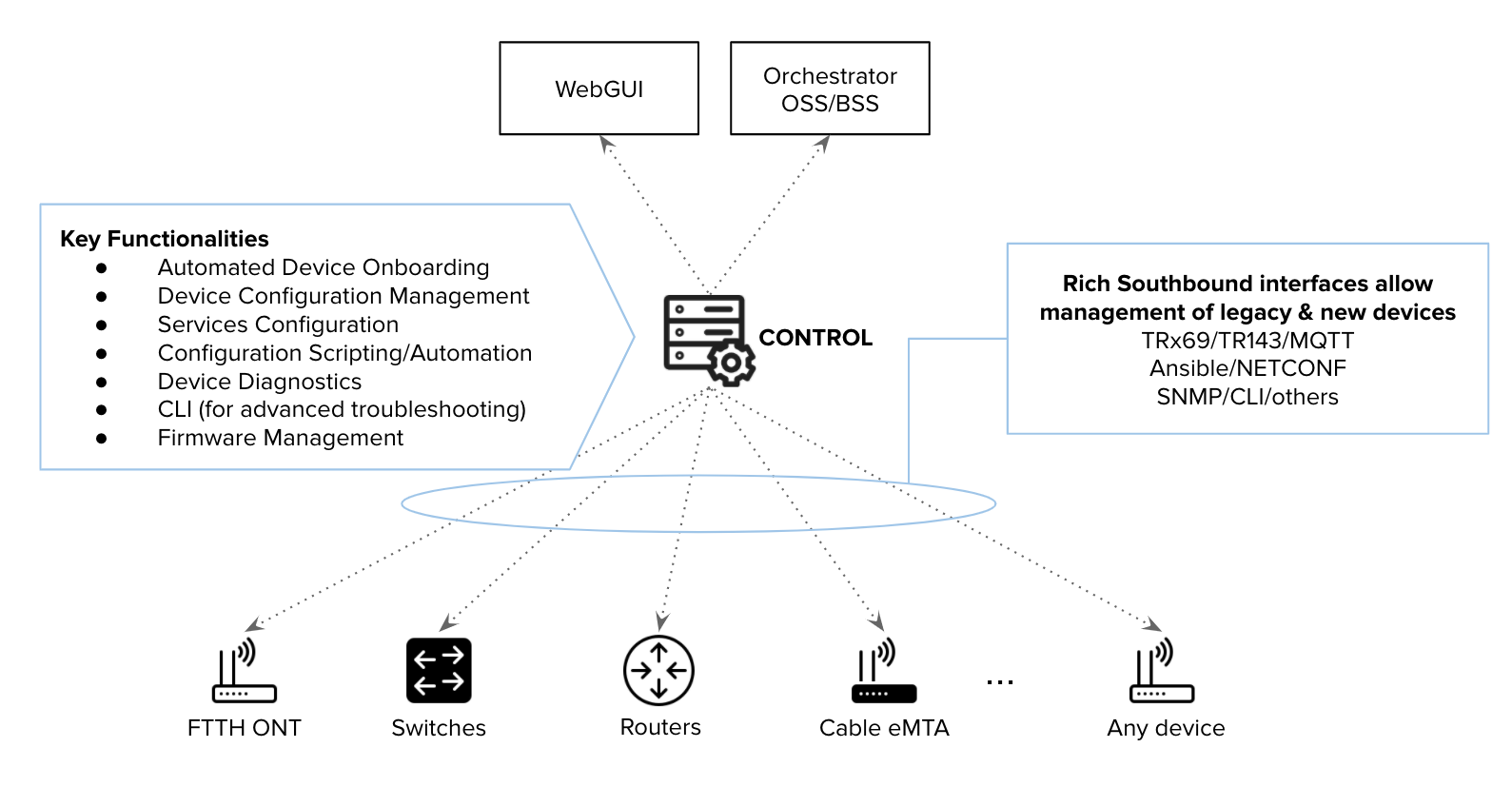
**CONTROL** is a multivendor and multiprotocol Device Management Platform, also known as an ACS (Automated Configuration Server). It enables service providers to efficiently manage and support customer premises equipment (CPE) regardless of manufacturer or device model.
## Key Capabilities
CONTROL provides comprehensive device management functionalities designed for service provider operations:
- **Automated Device Onboarding** – Streamlined provisioning of new devices
- **Device Configuration Management** – Centralized configuration control and version management
- **Services Configuration** – Service-level parameter configuration and deployment
- **Configuration Scripting/Automation** – Script-based workflows for bulk operations
- **Device Diagnostics** – Real-time monitoring and diagnostic tools
- **CLI Access** – Command-line interface for advanced troubleshooting
- **Firmware Management** – Centralized firmware updates and version control
## Protocol Support
CONTROL communicates with managed devices through standard and secure southbound protocols, including:
- TR-069 (CWMP)
- MQTT
- SNMP
- CLI
- Additional vendor-specific protocols
This multi-protocol approach ensures unified device management across different brands and models through a single platform.
## User Interface
### Web-Based GUI
CONTROL features a comprehensive web-based graphical user interface for configuration, settings management, and troubleshooting. The interface supports role-based access control with differentiated privilege levels:
- **Read-only** – View configuration and status information
- **Read-write** – Modify device settings and configurations
- **Admin** – Full platform administration capabilities
### RESTful API
All configuration settings and management actions are accessible through a flexible RESTful API, enabling seamless integration with existing OSS/BSS platforms and custom automation workflows.
## Additional Resources
- [Architecture](https://docs.zequenze.com/books/control/page/architecture)
- [Specifications](https://docs.zequenze.com/books/control/page/specifications)